A functional sectional couch can hide its true weight inside recliner frames, metal mechanisms, motors, and dense foam. That makes how to lift a heavy functional sectional couch a practical safety problem, not a simple strength test. One end may feel light, while the powered section pulls awkwardly toward the floor. Doors, stairs, and sharp hallway turns make the task harder.
The U.S. Bureau of Labor Statistics repeatedly identifies overexertion and bodily reaction among leading causes of workplace injuries. OSHA also recommends keeping heavy loads close to the body and avoiding twisting during lifts. Ergonomics researcher Dr. David Rempel offers a useful reminder: “Keep the load close to your body.” The advice sounds basic. It is often ignored.
This guide treats the sofa as a system, not one solid object. You will learn how to disconnect power, remove loose cushions, locate manufacturer-approved separation points, and use furniture sliders or lifting straps. Two or three adults may still be necessary, especially near stairs. A hand truck can help, but it can also damage reclining hardware when positioned carelessly. Measure the doorway first. Then measure again. That small pause prevents a frustrating surprise.
I have seen people focus on lifting power while ignoring hand placement and floor protection. That approach deserves reconsideration. The American Chiropractic Association and OSHA both emphasize controlled movement, neutral posture, and avoiding sudden force. Stop if the frame shifts, a motor catches, or someone loses visibility. A scratched floor is inconvenient; a strained back can affect daily life for weeks. Safety should guide every movement, even when the couch must move immediately.
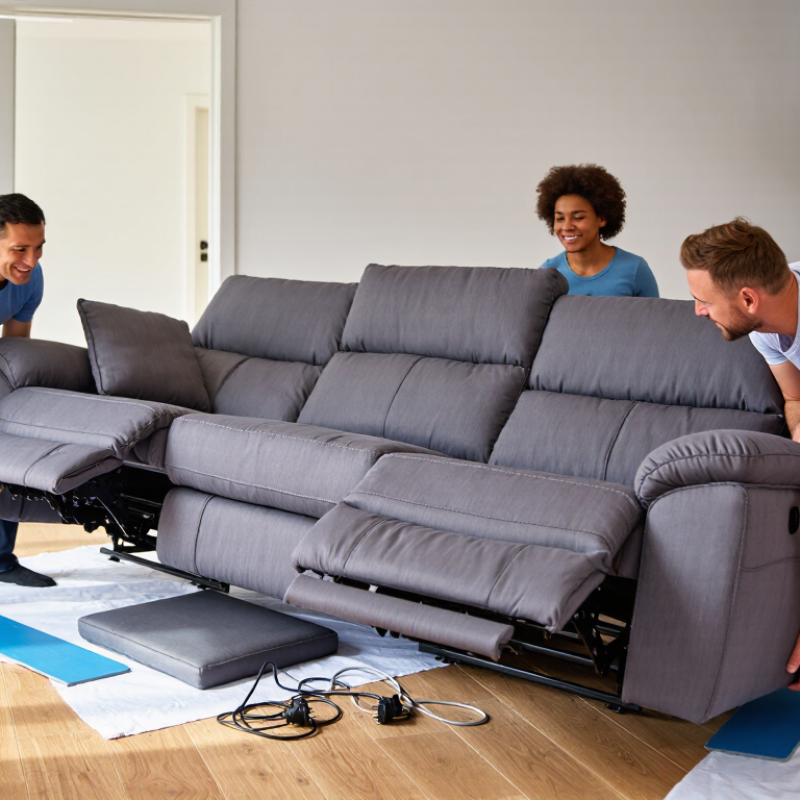
How to Lift a Heavy Functional Sectional Couch?
Assess the couch’s weight before touching it. A powered recliner section can feel much heavier than a fixed seat because motors, steel frames, and wiring concentrate weight. NIOSH’s Revised Lifting Equation uses 51 pounds as a load constant under ideal conditions. That figure is not a safe one-person limit for sofas. Distance, twisting, grip, and stairs reduce capacity quickly. My first estimate was wrong once I included the mechanism.
Measure each section, not only the complete couch. Record width, depth, height, and the narrowest corner. A long chaise may weigh less than a recliner base but create greater turning force. Remove cushions and detachable backs when the design allows it. Keep fingers away from metal hinges and electrical components. OSHA ergonomics guidance recommends reducing reach distance and improving handholds, which matters when carrying bulky furniture.
Inspect every sectional connection before lifting. Look underneath for interlocking brackets, clips, bolts, or sliding plates. Separate the units only after releasing the correct hardware. Never drag a connected sectional around a sharp landing; the frame can rack, and the fasteners may bend. Use a partner at each end, communicate every movement, and keep the load close to your torso. Stop if the couch blocks your view. That mistake is easy to underestimate. For powered sections, unplug the cord and protect it from crushing during movement.
Lifting a heavy functional sectional couch starts with preparation, not muscle. In practice, measure each section, doorway, hallway, and turn before moving anything. Check the manufacturer’s instructions, then disconnect power from reclining or adjustable components. Remove cushions, legs, consoles, and loose attachments to reduce weight and shifting. A four-wheel furniture dolly, lifting straps, corner protectors, moving blankets, and floor runners can make the route safer.
Clear the entire path. Keep children, pets, rugs, boxes, and small furniture away from the work area. Protect sharp corners and hardwood floors with padding. Confirm that elevators, stairs, and door thresholds can support the equipment and load.
The Liberty Mutual 2024 Workplace Safety Index estimated that overexertion involving outside sources cost U.S. employers 12.1 billion dollars in 2022. That figure shows why rushed handling deserves attention.
Keep the couch low, push rather than pull when possible, and communicate every movement. I sometimes underestimate tight corners. Rechecking the route prevents that mistake.
Tips: Use at least two capable adults, or more for oversized sections. Lift with bent knees and a neutral back. Do not twist while carrying. Let the dolly carry the weight, while one person guides from the front. Secure each section with straps before crossing a threshold. Stop if the load shifts, the path becomes blocked, or anyone loses balance. The U.S. Bureau of Labor Statistics consistently lists overexertion, slips, trips, and falls among major workplace injury categories. If the couch feels unstable, pause and redesign the move instead of forcing it.
Separate the functional sections before attempting to lift the couch. Check the assembly guide, then inspect the underside for connecting brackets, latches, or bolts. Unplug every power cord first. Never pull a recliner cable as a handle. Remove headrests, console inserts, cup holders, storage lids, and detachable cushions. Place small parts in labeled bags. Take photos before disconnecting anything. This saves time when the couch is reassembled.
Work with at least two strong adults, and add help for stairs or narrow turns. One person should guide the moving path while others support the frame. Lift from the solid base, not the reclining mechanism or armrests. Keep the sections upright when possible. A furniture dolly with thick straps can reduce strain, but secure each section firmly. Protect floors with moving blankets or cardboard. Measure doorways after removing loose components. That detail is easy to miss.
I once tried moving a sectional without removing its center console. It caught on the doorway and nearly twisted the frame. A slower approach would have prevented that mistake. Functional sections may connect with hidden hardware, so do not force them apart. If a latch feels stuck, stop and inspect it with a flashlight. Some models include wiring beneath the seats. Keep cables away from feet, wheels, and sharp edges. Lift smoothly. No sudden drops.
Lifting a functional sectional couch starts with a short team briefing. Measure doorways, hallways, and stair turns before touching the furniture. Remove cushions, legs, and detachable backs when the design allows it. Keep screws and small parts in labeled bags. The couch may look balanced, but its reclining mechanisms can shift the weight.
Use at least two strong adults for a manageable section, and add help for oversized pieces. One person should lead every movement with clear commands. Say “lift,” “hold,” and “lower” before anyone moves. Keep your back straight, bend your knees, and grip the frame rather than the upholstery. Lift together, not suddenly. Slow movements protect hands, walls, and flooring.
A furniture dolly can reduce strain on flat surfaces. Secure the section with straps, but never place pressure on moving controls. Carry each piece close to your body. Watch corners and exposed metal hardware. I once focused too much on the doorway and ignored a loose foot, which caused an awkward tilt. That mistake taught me to inspect every section again before lifting. If someone loses balance, lower the couch safely instead of trying to save the lift. Clear the path, wear closed-toe shoes, and pause whenever communication becomes unclear.
Moving a heavy functional sectional requires more than muscle. Plan the route before touching the couch. Measure doorways, turns, and elevator space. Remove cushions, headrests, and loose trays. Photograph each connection clearly. Label cables and detachable sections with simple tape. Unplug every powered feature. Do not guess.
Use two or three adults for each heavy section. Lift from the frame, not the reclining footrest or arm panels. Keep the piece close to your body and move slowly. A furniture dolly can help on level floors, but secure the section firmly. Protect floors with moving blankets or thick cardboard. I once rushed a doorway turn and scratched a wall. Extra planning would have prevented it.
In the new location, match each labeled section with its photographs. Align the brackets before applying pressure. Reconnect power cables only after the frame sits evenly. Check that every latch is fully engaged. Loose connections can make the couch shift during use. Test each seat separately: recline, close, adjust the headrest, and check the controls. Listen for grinding, clicking, or uneven movement. Sit gently on every section and inspect the gaps between modules. If a mechanism feels stiff, stop and review the assembly instructions rather than forcing it. One missed cable can leave a whole seat unusable.
| Phase | Task or Checkpoint | Recommended Data / Target | Equipment or Method | People | Estimated Time | Safety Standard |
|---|---|---|---|---|---|---|
| 1. Prepare | Measure the sectional and the route | Record each module’s width, height, depth, and diagonal height; allow at least 25–50 mm of clearance at tight points. | Tape measure; paper or phone sketch | 2 people | 15–25 min | Do not rely on visual clearance alone. |
| Estimate the load | A powered or reclining sectional commonly weighs about 115–225 kg (250–500 lb) in total, depending on size and mechanism. | Manufacturer label or household scale for individual modules, when available | 2–4 people | 10–15 min | Never lift a complete powered sectional as one piece. | |
| Prepare the new location | Create a level, dry area larger than the assembled footprint; keep outlets accessible and provide approximately 75–100 mm behind reclining backs where required. | Furniture sliders; floor protection; clearance marks | 1–2 people | 10–20 min | Keep pathways free from rugs, toys, and loose cables. | |
| Disconnect power | Unplug the power supply and any accessory cables; label connectors before separation. | Cable labels; resealable bags; flashlight | 1 person | 5–10 min | Disconnect from the wall before handling electrical connections. | |
| 2. Disassemble | Remove loose cushions and accessories | Remove back cushions, headrests, consoles, trays, and storage contents; keep hardware with its module. | Plastic bags; labels; marker | 1–2 people | 10–15 min | Do not pull cushions by electrical wires or control cables. |
| Close the reclining mechanisms | Return every footrest and headrest to its fully closed position before moving. | Hand controls; visual inspection | 1 person | 5 min | Keep hands and feet away from hinges and moving joints. | |
| Separate the modules | Release metal brackets, clamps, or connector hooks according to the sectional’s construction; do not force stuck fittings. | Correct-size wrench or screwdriver; work gloves | 2 people | 15–30 min | Support both sides while releasing connectors. | |
| Protect frames and floors | Wrap corners and place padded barriers between upholstery, walls, door frames, and flooring. | Moving blankets; stretch wrap; corner protectors | 2 people | 10–20 min | Do not drag fabric or place weight on armrests. | |
| 3. Lift and Move | Choose the lifting position | Lift from the structural base or frame rails; avoid reclining legs, controls, cup holders, and removable upholstery. | Work gloves; lifting straps if suitable | 2–4 people | 5–10 min | Assign one person to give commands. |
| Move through doors and turns | Keep the module upright when possible; pivot slowly and protect corners at thresholds. | Furniture dolly; sliders; ramps for thresholds | 2–4 people | 15–40 min | Never place fingers under the base while lowering. | |
| Set modules in the new room | Place modules on the planned footprint with equal spacing and enough clearance for every moving section. | Floor plan; measuring tape; sliders | 2–4 people | 10–20 min | Lower the load together and keep the floor level. | |
| 4. Reassemble | Reconnect the sectional modules | Align connector hardware without gaps, rocking, or uneven seams; tighten only until secure. | Correct-size hand tools; flashlight | 2 people | 15–30 min | Do not overtighten bolts into wood or deform brackets. |
| Reconnect electrical components | Match labeled plugs and keep all cables clear of reclining frames, pinch points, and floor traffic. | Cable ties; cable clips; labels | 1–2 people | 10–15 min | Plug in only after all mechanical connections are complete. | |
| Replace cushions and headrests | Confirm each cushion is centered, secured, and not blocking a hinge, latch, or air gap. | Visual inspection; hand check | 1–2 people | 10–15 min | Keep removable parts away from children during setup. | |
| 5. Test | Check stability | Sit briefly on each seat and verify that the frame does not shift, rock, or separate. | Visual and hands-on inspection | 2 people | 5–10 min | Stop immediately if a connector moves or makes a sharp noise. |
| Test each reclining seat | Open and close each mechanism through one complete cycle; confirm smooth travel and full closure. | Hand control; clear observation area | 1–2 people | 10–15 min | Keep hands, pets, and objects away from moving parts. | |
| Inspect cables and power | Check for heat, damage, loose plugs, stretched cables, or contact with metal mechanisms. | Flashlight; visual inspection | 1 person | 5–10 min | Unplug the unit if any cable becomes warm or damaged. | |
| Complete the final room check | Confirm clear walkways, stable placement, accessible controls, adequate wall clearance, and no trapped cables. | Final checklist; tape measure | 2 people | 5–10 min | Do not use the sectional until every check passes. |
Measure doorways, hallways, stair turns, and elevator space. Remove cushions, legs, and detachable backs when possible. The couch may look balanced, but reclining parts can shift its weight.
Use at least two capable adults for a manageable section. Add help for oversized pieces. One person should lead every movement. Move together.
Grip the solid frame, not the upholstery, footrest, or arm panels. Keep your back straight and bend your knees. Carry the section close to your body.
Clear the route and wear closed-toe shoes. Use moving blankets or thick cardboard on the floor. A furniture dolly helps on level surfaces. Secure the section without pressing moving controls.
Lower the couch safely instead of rescuing the lift. Stop when communication becomes unclear. A loose foot once caused an awkward tilt. I should have inspected it again.
Photograph every connection before disassembly. Place screws and small parts in labeled bags. Mark cables and sections with simple tape. Unplug every powered feature. Do not guess.
Match each labeled section with its photographs. Align the brackets before applying pressure. Check every latch until it is fully engaged. Reconnect power only after the frame sits evenly.
Test every seat separately. Recline, close, adjust the headrest, and check the controls. Listen for grinding, clicking, or uneven movement. Sit gently and inspect gaps between sections. Stop if a mechanism feels stiff.
Learning how to lift a heavy functional sectional couch begins with understanding its weight, shape, reclining mechanisms, and connection points. Before moving it, measure doorways and hallways, clear obstacles, protect floors, and gather suitable equipment such as furniture straps, moving blankets, gloves, and a sturdy dolly. Disconnect power cords if the couch has functional features, then separate the sectional pieces and remove cushions, legs, tables, or other loose components to reduce weight and improve balance.
When considering how to lift a heavy functional sectional couch, use at least two capable people and communicate clearly throughout the process. Lift with your legs, keep the load close, avoid twisting, and move one section at a time while supporting its frame. Once the couch reaches its new location, reconnect the sections securely, reinstall all removed parts, and check that the seating, reclining, and electrical functions operate properly. Take your time to prevent damage or injury.
