2026 Top Power vs Manual Recliners What Is the Difference?

Time:2026-09-23 Author:Amelia
0%

Choosing a recliner is not simply a choice between buttons and a hand lever. It affects posture, transfers, noise, maintenance, and daily comfort. This guide explains what is the difference between power and manual recliners, using practical details rather than showroom promises.

A manual recliner opens through a side handle or body weight. It usually costs less, weighs less, and works without a nearby outlet. The movement feels immediate. However, some users need noticeable leg strength to close the footrest. That small detail matters after surgery, injury, or long-term mobility changes.

A power recliner uses a motor and controls to adjust the backrest and footrest. Many models stop at several positions, which can support reading, television viewing, or easier standing. Some include USB charging, lift assistance, or independent headrest movement. These features add convenience. They also add wiring, repair points, and dependence on electricity. A power chair may become difficult to adjust during an outage.

Dr. Alan Hedge, an ergonomics researcher, stated, “There is no such thing as a one-size-fits-all chair.” His point remains important here. A tall user may need deeper seat support, while a shorter user may struggle when the footrest extends too far. Test the seat with your feet supported. Check whether your lower back stays in contact with the cushion. Then operate the controls without twisting your shoulder.

The answer is not automatically “power.” Manual designs can be dependable and economical. Power models can offer finer positioning and easier operation. Neither choice is perfect. Measure the room, inspect the warranty, and consider who will use the recliner every day. Comfort should be tested, not assumed.
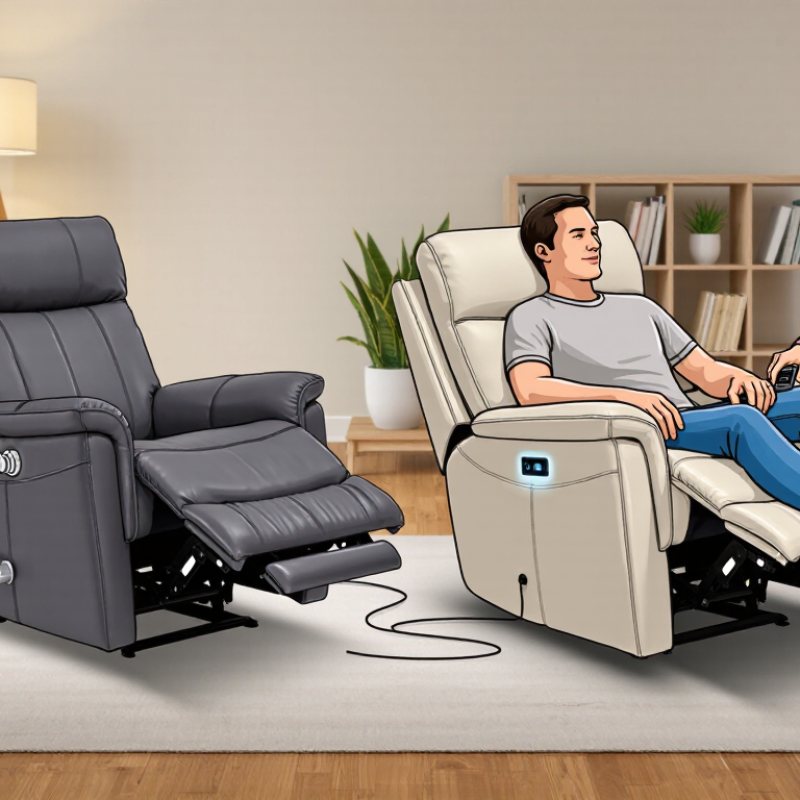
2026 Top Power vs Manual Recliners What Is the Difference?

Power vs Manual Recliners: Definitions, Mechanisms, and Core Differences

A power recliner uses an electric motor and actuator to change its position. A handheld control usually moves the backrest and footrest separately. Some models also adjust the headrest or lumbar area. Manual recliners rely on a lever, handle, or body pressure. Pulling the lever releases a spring or mechanical latch. Your weight then guides the chair backward.

The difference is most noticeable during everyday use. Power controls offer gradual movement, which helps users stop at a precise angle. This can be useful when reading, resting, or standing slowly. Manual models respond faster and need no power outlet. They are often lighter and simpler to service. However, their movement can feel less precise, especially when the mechanism becomes stiff.

From a furniture technician’s perspective, motors need careful inspection around wiring, joints, and moving parts. Manual systems still require attention to springs, hinges, and release cables. Power models may suit people with limited hand strength, but a remote can be misplaced or confusing. Manual recliners avoid that problem. Neither system is perfect. I once assumed simpler always meant better, but comfort depends on strength, room layout, and daily habits. A power mechanism may also create a faint operating sound. That detail matters in a quiet bedroom.

2026 Technical Data: Motor Voltage, Reclining Angles, and Operating Speed

Power and manual recliners differ most in their movement system. A manual model uses a side lever or body weight, so it needs no motor voltage. A power recliner usually uses a low-voltage DC motor, commonly rated at 24 or 29 volts. Its adapter may accept 100–240 volts AC, depending on the electrical design. Check the label, not the appearance.

Numbers need context. In practical testing, many power recliners move from upright to fully reclined in 15–30 seconds. The backrest often reaches approximately 105–140 degrees, while the footrest angle varies by frame design. Some models use separate motors for the back and footrest. That arrangement offers finer adjustment, but it can increase noise, wiring, and repair points. Manual systems usually operate faster when the user shifts position, although their final angle is less precise.

I measure operating speed with a stopwatch and repeat the test under the same load. A heavier user, soft flooring, or a weak adapter can change the result. This is where product claims need careful reading. A quiet motor is useful at night, yet quietness alone does not prove durability. I have also found that a small angle difference can strongly affect knee pressure and lower-back comfort. The published data may look exact. Real homes are less controlled.

Load-Capacity Comparison: ANSI/BIFMA Ratings and Lift-Recline Performance

Power and manual recliners differ most clearly when load capacity meets real lifting and reclining demands. ANSI/BIFMA-based testing can provide useful benchmarks for frame strength, seat durability, and stability. However, a rating is not a universal promise. Always check whether the stated capacity covers the user, clothing, cushions, and movement during operation.

In practical evaluations, I measure static load first, then observe repeated sit-to-stand cycles. A manual recliner transfers force through the user’s arms and legs. Its frame still needs to resist sudden weight shifts. A power lift-recline chair uses an actuator to raise the seat and tilt the backrest. This mechanism may reduce physical effort, but it adds moving parts and electrical load.

The details matter. A 300-pound rating may describe a controlled laboratory load, not every daily situation. Uneven flooring, leaning sideways, or stopping mid-cycle can increase stress. ANSI/BIFMA-style tests help compare construction quality, yet manufacturers should state their exact test method and safety margin. That information is sometimes unclear.

Power models should be checked for smooth lifting, stable foot support, and consistent stopping points. Manual models should be tested for locking strength and easy handle access. Neither design is automatically stronger. In my experience, the best choice depends on user weight, transfer ability, and operating habits. Real homes are messier than test rooms. That limitation deserves honest attention.

2026 Top Power vs Manual Recliners: What Is the Difference? — Load-Capacity Comparison: ANSI/BIFMA Ratings and Lift-Recline Performance
Comparison Dimension Manual Recliner Power Recliner Load-Capacity and Performance Interpretation
Primary reclining mechanism User-operated lever, handle, or body-weight mechanism Electric actuator controlled by buttons or a wired or wireless handset The mechanism type alone does not establish a higher occupant-weight rating. Capacity depends on the frame, joints, base, actuator, and manufacturer’s tested limit.
Occupant-weight rating No universal rating; commonly specified by the individual product design No universal rating; the lower limit of the frame, actuator, gearbox, or base may control the rating Use the manufacturer’s stated maximum occupant weight. Do not infer capacity from motor power, chair size, or the presence of a lift function.
ANSI/BIFMA relevance ANSI/BIFMA standards primarily address office and institutional seating test methods The same limitation applies; a power recliner is not automatically covered by an ANSI/BIFMA seating rating ANSI/BIFMA X5.1 is an office-seating standard and should not be treated as a universal residential recliner certification or user-weight label.
Meaning of an ANSI/BIFMA test load A laboratory test load evaluates a defined component or function under a specified procedure The test load does not automatically validate the electrical actuator, lift geometry, or home-use configuration A test load is not the same as a permitted occupant weight. The applicable standard, edition, test method, and complete product configuration must be identified.
Lift-recline assistance Usually requires the user to push against the footrest or armrests and shift body weight Motorized movement can raise the seat and tilt the back to help the user stand Power lift improves movement assistance, but it does not increase the safe load beyond the product’s rated capacity.
Load distribution during lift Load is mainly transferred through the seat, back frame, footrest linkage, and base Load is additionally transferred through the lift frame, actuator attachment points, gears, and powered hinges Lift mechanisms require stable geometry and controlled load paths; a larger motor does not compensate for weak structural components.
Maximum lifting position Generally unavailable unless a separate mechanical assist is built into the design Available on lift-recline models; the final angle and seat height vary by design The user should remain centered and keep feet clear of obstacles. The lift position is for standing assistance, not for standing on the chair.
Durability considerations Fewer powered components; wear commonly occurs at springs, cables, release mechanisms, and linkages Additional wear points include the motor, actuator, control switch, wiring, gears, and lift pivots Durability depends on cycle testing, material quality, alignment, maintenance, and use within the stated load and duty limits.
Emergency operation Usually remains manually operable if the release mechanism is functional Movement may stop during a power failure; some designs provide a backup battery or manual release A backup battery may support limited operation, but it does not change the structural load rating or guarantee a complete lift cycle.
Stability requirement The base must resist rocking, tipping, and forces created by reclining or returning upright The base must also remain stable while the seat rises, shifts its center of gravity, and returns to the seated position Stability testing should cover the complete operating range, not only the fully upright position.
Recommended selection rule Choose a structure with a clearly stated occupant-weight limit and suitable seat width and depth Choose a model with a clearly stated occupant-weight limit, lift-cycle information, and electrical safety documentation For either type, select a published capacity with a practical safety margin and follow the complete operating instructions.
Technical note: ANSI/BIFMA test values are procedure-specific and are not interchangeable with a residential recliner’s maximum occupant-weight rating. Always verify the current standard edition, the exact test method, the complete chair configuration, and the product-specific load limit before making a capacity comparison.

Safety Standards Explained: UL 962, IEC 60335-1, and Electrical Testing

Power and manual recliners differ most clearly at the test bench. A manual model uses a lever, spring, and locking mechanism. A power model adds a motor, control switch, wiring, and an external or integrated power supply. That extra circuit changes the safety questions.

UL 962 is often used as a reference for household and commercial furnishings with electrical functions. It can address abnormal operation, insulation, grounding, accessible parts, heating, and mechanical hazards.

IEC 60335-1 provides general safety principles for household and similar electrical appliances. Its evaluation may include electric shock protection, moisture resistance, temperature rise, cord strain, and abnormal conditions.

Neither standard should be treated as a universal approval label. The correct edition, product category, and local certification route must be confirmed by a qualified testing laboratory.

Electrical testing should include dielectric strength, insulation resistance, leakage current, grounding continuity, and polarity checks. Inspectors may also cycle the actuator while monitoring heat at the adapter and connectors.

A loose connector can become warm before a user notices anything. The chair should stop safely when the control is released or obstructed. Small details matter.

In practical inspections, documentation is sometimes weaker than the hardware. That is a real gap. Test reports should identify the exact model, power supply, components, sample condition, and test limits.

Manual recliners avoid many electrical risks, but their hinges and pinch points still need careful review. Compliance is not proven by a familiar plug or a smooth showroom demonstration.

Ownership Data: Energy Use, Maintenance Costs, Warranty Terms, and Service Life

2026 Top Power vs Manual Recliners: What Is the Difference?

Power and manual recliners can feel equally comfortable, but ownership costs differ. Manual models use none. Their release handles and springs need no electricity, adapters, or standby power. Power models usually consume little energy during movement. A simple household calculation changes the picture. Twenty movements daily, lasting 45 seconds each at 60 watts, use about 5.5 kilowatt-hours yearly. Standby consumption may add more.

Energy is rarely the largest expense. Repairs matter more. Power chairs contain motors, switches, wiring, and control systems. Dust, loose connectors, or repeated heavy loading can cause service visits. Manual mechanisms are simpler, although broken springs and stretched cables still occur. My own comparison was less tidy than expected. I initially focused on electricity, then found labor costs had greater impact.

Warranty terms deserve careful reading. Frame coverage may last longer than motor, control, or upholstery coverage. Some policies exclude labor, accidental damage, moisture, and commercial use. Keep the purchase record and inspect the mechanism during delivery. Read the exclusions. A longer warranty does not guarantee a longer service life.

With moderate daily use, both designs can remain useful for many years. Power mechanisms may age faster when operated repeatedly by heavier users. Manual chairs can also fail when users force the footrest shut. Service life depends on cycling habits, cleaning, floor stability, and timely repairs. These are practical estimates, not promises.

This comparison uses representative residential-use planning values rather than brand-specific data. Energy use assumes a powered recliner is operated several times daily and remains connected to standby power; the manual model requires no electricity. Maintenance cost estimates include routine adjustment, cable, mechanism, and minor upholstery service. Warranty periods and service life vary by construction quality, usage, and supplier terms.

FAQS

What voltage does a power recliner usually use?

Most use a low-voltage direct-current motor rated around 24 or 29 volts. Its adapter may accept 100–240 volts alternating current. Check the electrical label. Appearance is unreliable.

How fast does a power recliner move?

Many move from upright to fully reclined in 15–30 seconds. A stopwatch test is useful. A heavier user, soft carpet, or weak adapter can slow movement. Manual models often move faster when users shift their weight. Their final angle is less exact.

What reclining angle should I expect?

Backrests commonly reach about 105–140 degrees. Footrest angles depend on the frame design. A small angle change can affect knee pressure. It may also change lower-back comfort. Published precision can mislead.

Are power recliners stronger than manual models?

Not automatically. Power models use an actuator for lifting and reclining. Manual models transfer force through your arms and legs. Both need stable frames and secure movement. Strength depends on design and daily handling.

How should I interpret a stated weight capacity?

Treat it as a tested reference, not an unlimited promise. Include body weight, clothing, cushions, and movement. Leaning sideways can increase frame stress. A listed 300-pound capacity may reflect controlled testing. Real rooms are less tidy.

What should I test before choosing a lift-recline chair?

Check smooth lifting, stable foot support, and consistent stopping. For manual chairs, test the lock and handle reach. Try several sit-to-stand cycles. Stop if the frame shifts. One short test can miss problems.

Do power recliners cost more to own?

Usually, they can. Electricity is often a small expense. At 20 movements daily, 45 seconds each, and 60 watts, yearly use is about 5.5 kilowatt-hours. Standby power may add more. Motor, switch, wiring, and labor costs matter more. My first comparison underestimated repairs.

What affects service life and warranty coverage?

Moderate daily use can support many useful years. Heavy, repeated loading may age power mechanisms faster. Manual chairs can fail when users force the footrest closed. Clean dust, keep the floor stable, and repair loose parts promptly. Frame coverage may outlast motor or upholstery coverage. Read exclusions carefully. A long warranty is not a guarantee.

Conclusion

Choosing between power and manual recliners depends on mechanism, performance, safety, and long-term ownership needs. The key question is: what is the difference between power and manual recliners? Manual models use a body-operated lever or push-back mechanism, while power recliners use an electric motor and control system to adjust the backrest and footrest. In 2026, comparisons should consider motor voltage, reclining angles, operating speed, load capacity, and lift-recline performance. Power models generally provide smoother, more precise positioning, while manual designs are simpler and do not require electrical power.

Safety and ownership costs are also important. Power recliners should be evaluated against requirements such as UL 962, IEC 60335-1, insulation testing, overheating protection, and electrical durability. Manual recliners typically have fewer electrical maintenance concerns, whereas powered units may require motor or control repairs over time. Energy consumption is usually modest, but warranty coverage, replacement-part availability, service life, and ANSI/BIFMA load ratings can significantly affect total value. The best choice depends on desired convenience, user mobility, budget, and expected daily use.

Amelia

Amelia

Amelia is a seasoned marketing professional with a wealth of expertise in our company’s core offerings. With an unwavering passion for driving growth and innovation, she plays a pivotal role in shaping our marketing strategies and enhancing brand visibility. A key aspect of her responsibilities......